You know this moment, you’ve outgrown cafés. Your team is tired of working from home, and suddenly, “we need an office” becomes a real office. Then comes the advice, “Just take a lease.” Sounds simple. Feels like progress. But it’s also one of the most expensive, irreversible decisions you’ll make early on.
Because here’s what most people don’t tell you: you’re not choosing between two types of offices. You’re choosing between locking capital into real estate and keeping your business flexible enough to survive reality.
That’s exactly why coworking space providers like Nukleus are seeing a sharp rise in adoption. Instead of empty spaces you have to build and manage, they offer fully serviced, ready-to-use workspaces across Delhi NCR, Bangalore, and many more places.
So before you sign anything, before the deposit, the interiors, the 5-year lock-in, it’s worth asking a better question:
Are you building a company, or managing an office?
The Core Difference: What You Are Actually Paying For
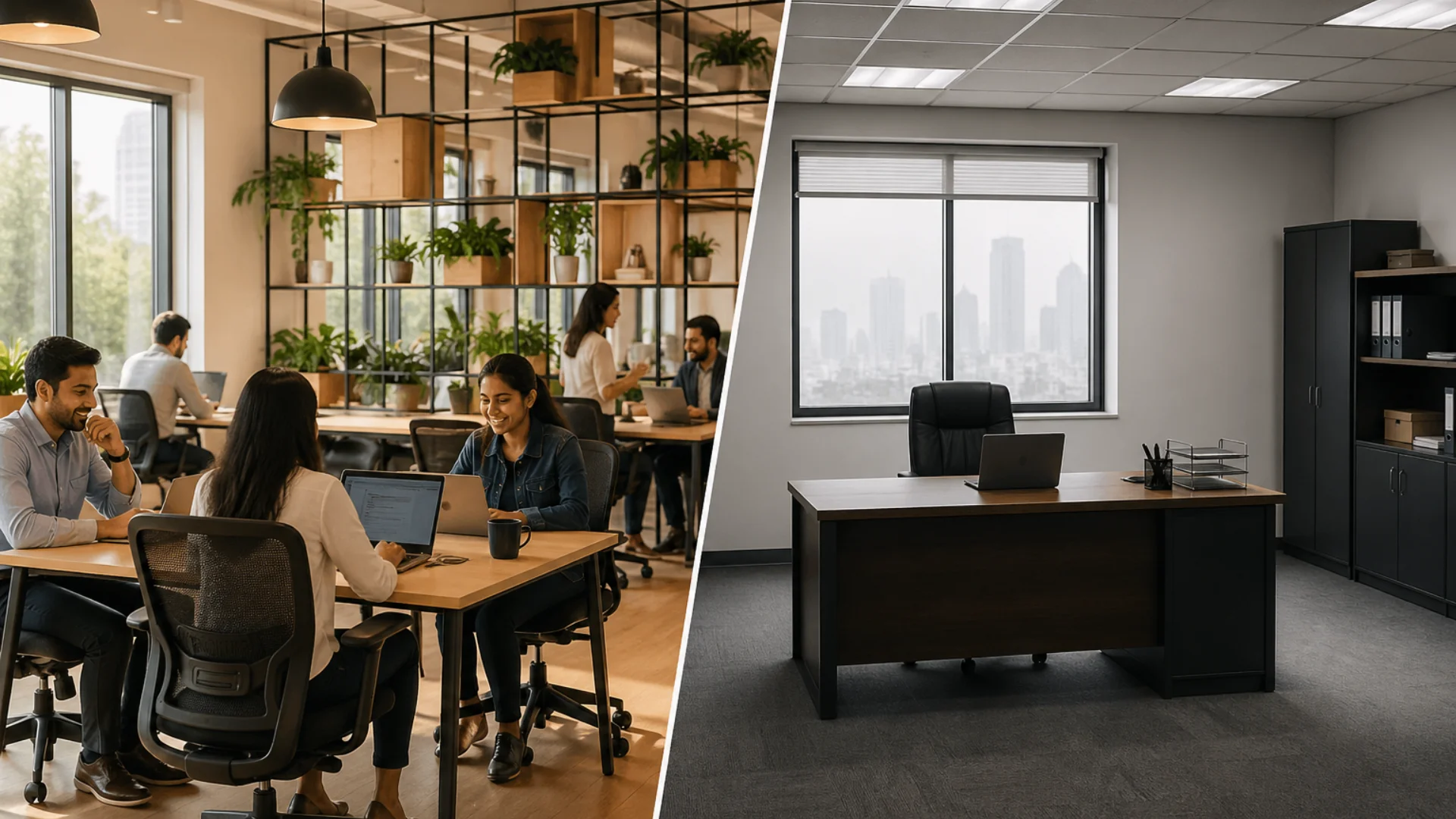
Here's the thing nobody says out loud at property walkthroughs: a traditional office lease is not just a rent agreement. It's a capital commitment. You're paying for walls. Empty walls. The internet, the furniture, the AC maintenance, the security guard, the coffee machine, that's all on you, billed separately, every single month.
On the other hand, a coworking membership with providers like Nukleus is a bundled operating expense. You're paying for a fully functioning workspace, with fibre internet, housekeeping, front-desk staff, meeting rooms, printer, and pantry, included in one clean monthly invoice. That's an entirely different product dressed in the same "office" vocabulary.
What You're Paying For
| What You're Paying For | Traditional Office | Coworking Space |
|---|---|---|
| Space (raw sq footage) | Included | Included |
| Furniture & fit-out | Separate cost | Included |
| High-speed internet | Separate vendor | Included |
| Housekeeping & maintenance | Separate cost | Included |
| Meeting rooms | Build at own cost | Bookable on demand |
| Reception & front desk | Your hire | Included |
| Community & networking | Not available | Built-in |
| Flexibility to scale | 3–9 year lock-in | Monthly to annual |
| GST-compliant invoicing | Depends on the landlord | Yes, always |
Flexible workspace take-up across India has grown steadily, driven by companies realising they were paying for infrastructure they didn't need to own. That's not a trend. That's a structural shift.
Hidden Costs of a Traditional Office That Nobody Talks About
Let's say you find a nice 1,500 sq ft office in a decent commercial building in Noida Sector 62. The landlord quotes ₹70 per sq ft. "Only ₹1.05 lakh per month," he says cheerfully. What he doesn't mention:1. Security Deposit: ₹6-12 Lakhs, upfront
Most commercial landlords in Delhi NCR demand 6 to 12 months' rent as a refundable deposit. That's dead capital sitting in someone else's account while you try to build a business.2. Brokerage: 2-3 Months' Rent
Your broker, who showed you four properties over two weekends, collects 2 to 3 months' rent as commission. On a ₹1.05L/month lease, that's ₹2–3 lakhs, gone before you've moved in a single desk.3. Fit-Out & Interior: ₹8-20 Lakhs
A raw shell needs flooring, false ceiling, electrical points, air conditioning, partitions, furniture, and even a basic setup for 15 people runs ₹8-12 lakhs. Premium? Double it.4. IT Infrastructure: ₹2-5 Lakhs
Leased line connection (because building Wi-Fi won't cut it), server rack or cloud setup, switches, CCTV, each a separate vendor, separate invoice, separate headache.
5. Ongoing Overheads: ₹20,000-50,000/month on top of rent
Power bills, water, housekeeping staff, AMC for AC units, and that one printer that will always need ink at the worst possible time.
For most SMBs and early-stage companies, the total first-year cost of a traditional office — deposit, fit-out, brokerage and overheads together — runs substantially higher than an equivalent coworking membership. And that's before factoring in the opportunity cost of time spent managing the space.
Flexibility Comparison: Lock-In, Scalability, and Exit
The thing about a traditional office lease is it's written for the landlord's stability, not yours. You're locking in 3, 5, sometimes 9 years of your company's future on a forecast that didn't account for a pandemic, a pivot, a funding round, or a bad hiring quarter. Leases in NCR also carry long exit notice periods and heavy penalties for leaving early.
"You don't sign a lease for who you are today.
You sign it for who you might not be in three years."
Coworking flips this entirely. Month-to-month memberships for hot desks. 3 to 12-month agreements for dedicated desks and private cabins. Managed office floors on 12-month rolling contracts with scale-up clauses built in. Want to add 10 desks next quarter? Done. Want to downsize from 30 to 15 people after a restructuring? Not a legal battle, just a conversation.
| Flexibility Comparison | Traditional | Coworking |
|---|---|---|
| Typical lease duration | 3-9 years | 1 month-24 months |
| Exit notice period | 3–6 months | 30–60 days |
| Scale up (add seats) | Renegotiate lease | Same-day availability |
| Scale down | Penalty clauses apply | Adjust at renewal |
| Multi-city expansion | New lease per city | One operator, multiple cities |
| Remote-first hybrid model | Paying for empty desks | Pay only for what's used |
Who Should Choose Coworking vs Traditional Office
There is no universal answer, and anyone selling you one is either a coworking operator or a property broker. Here's an honest decision matrix based on where you actually are as a business.Choose Coworking If You Are…
- A startup under 3 years old with uncertain headcount
- A remote-first team that needs a base, not a full office
- Expanding into a new city (Delhi NCR, Bangalore) without a committed local team yet
- A freelancer or consultant needing a professional business address and occasional meeting space
- An enterprise team that needs a satellite location without a separate lease
- A company using a hybrid work model with rotating desk usage
Consider Traditional If You Are…
- A 200+ person team with stable, predictable headcount for 5+ years
- In a regulated sector (banking, defence, pharma) requiring strict data and access controls
- Needing custom infrastructure, impossible to retrofit (server rooms, lab setups)
- Operating in a Tier-2 city with no quality coworking options available
Even for the "consider traditional" column, managed office space providers like Nukleus now offer enterprise-grade private floors with custom branding, access control, and dedicated internet. The line between "coworking" and "traditional" is collapsing faster than most people realise.
How the Hybrid Work Model Changed the Office Equation in India
If there was one thing post-2020 India proved, it's that the office is not dead, it's just optional on Tuesdays. A large share of knowledge workers in metro cities now operate on some form of hybrid work model, splitting time between home and office. That means on any given day, a company with 30 desks might have far fewer people showing up.
And yet, if you have a traditional lease, you're paying for all 30 desks. Every single day. Including weekends.
This is precisely where coworking spaces in Delhi NCR, Noida, Gurgaon, and Bangalore have captured massive demand. Teams can book the space they need, when they need it, day passes for full-team days, monthly memberships for core members, and meeting rooms on demand.
The hybrid work model isn't just about flexibility; it's about not paying rent for air.
Why Location Quality Matters More Than Square Footage
Here's something nobody puts in a brochure: your office address is part of your brand.
A 3,000 sq ft office in a random lane does less for credibility than a small cabin in a prime business district. Clients Google your address. Candidates check it. Investors notice it.
The rise of premium coworking locations isn't about vanity; it's about perception ROI.
Being in the right location signals:
- Stability
- Credibility
- Seriousness
For global companies entering India, even a virtual office at a strong address can change how you're perceived.
Conclusion
At the end of the day, this isn’t really about coworking vs traditional offices. It’s about how much certainty you actually have.
If your team size, cash flow, and plans are locked in for the next 5-7 years, a lease can make sense. But most businesses aren’t operating with that kind of predictability anymore. Teams grow, shrink, go hybrid, expand to new cities, sometimes all within a year.
And that’s where the old office model starts to feel heavy.
You’re not just paying rent. You’re managing vendors, maintaining infrastructure, and sitting on a long-term commitment that may or may not match where your business is headed.
Spaces like Nukleus exist for exactly this shift. You get a proper coworking office setup, the kind you’d actually be comfortable bringing clients to, without having to build it from scratch or commit years in advance. Whether it’s a few desks, a private cabin, or a full team setup, it moves with you.
If you’re at that stage where you know you need an office, but you’re not ready to lock yourself into one version of the future, it’s worth exploring what that flexibility looks like in practice.
FAQs
1. Is a coworking space actually cheaper than a traditional office in India?
Yes, significantly for most SMBs. Once you include deposits, interiors and overheads, the first-year cost of coworking is typically well below that of a comparable leased office.
2. Can a company of 50+ people use a coworking space?
Yes. Managed offices support teams from 20 to 200+ with private, branded spaces.
3. What is the typical lock-in period?
1–12 months for coworking vs 3–5 years for traditional leases.
4. Do coworking spaces provide GST invoices?
Yes, fully compliant with input tax credit benefits.
5. Is a coworking address professional enough?
Yes. Often more impressive than traditional offices.
6. Can I have a private office within coworking?
Yes. Private cabins and managed floors are available.
7. What if I want occasional access only?
Day passes, and flexible memberships solve exactly that use case.